

When the Parsonage Falls Quiet
On Emily Brontë - and the space we fill

It was one of those days when the sky’s curtains remained half-drawn. Early February – that rut on the slow way out of winter. All the water hung suspended in the air, thickening between hills and gathering in the wool of shaggy, soft-footed sheep. Haworth in the mist was noiseless and still. Haworth in the mist was silken, sullen… and oh so appropriate.
‘Isn’t this fitting?’ I say, shaking off droplets at the doorstep of the café.
‘So atmospheric!’ says Chris. He is the person who, just over a week ago, sent a somewhat hurried email inviting me here, today. To film a conversation about Emily Brontë and her Wuthering Heights, in the very place she lived, and wrote it. Knowing, I suppose, that I live within reach, he asked if I would chair the discussion. My first response was to think, my goodness, me? I love doing events, but am I the right person to hold space for such a monumental book? My teenage self, whose frenzied tapestry of notes crowd the narrow margins in my copy of Wuthering Heights, gave me a dig in the ribs. My second response was to reply to Chris with a resounding: Yes.
My husband Andrew slips into a corner table and takes out his laptop. We fitted this stop surreptitiously into our existing plans to travel for a family holiday, so he’s here for the ride – and as happy as I am for an excuse to pass through these beautiful West Yorkshire grooves again.
Chris and I catch up, exchanging updates in our working, book-related worlds. I know him through the magazine’s partnership dealings with Hay Festival, and his enthusiasm for what we’re trying to achieve with Folding Rock.
After a little while, Chris leaves to go and get everything ready. With just a few hundred yards to the Parsonage, I promise him that I won’t be late. I shuffle over to join Andrew, and we order another coffee.
The Brontë Parsonage Museum is the surviving monument to that most famous family. It is a place held in time: painstakingly preserved so as to long outlive all its ill-fated inhabitants. The house, now, is full of its own myth and history. Its walls are papered with patterns the sisters would have stared at from their pillows, wide awake in early dawn, minds elsewhere. It is full of their possessions: Anne’s writing things, Charlotte’s spectacles, those tiny gloves. It is full of the invisible imprint of lives once lived. And, most days, it is full of visiting tourists.
When I first came to Haworth, as an English Undergrad completely immersed in the literature of these women and their contemporaries, I had very mixed feelings. On one hand I felt breathless with the atmosphere of the place – of its direct connection to the past, of being able to walk the same lines that they had. People I had thought so deeply about, whose words I had read and inhabited, and who, ultimately, I knew so little about. But as I stood on the landing between their bedroom doors, fixed by the traffic jam of curious people cycling through each red-roped diorama, I felt unspeakably sad, too.
Today is a Tuesday, out of season, and the parsonage is closed to the public. This means that for the first and probably only time in my life, I will get the place (almost) to myself.
Chris texts just before our planned start time: All ready. Everyone here!
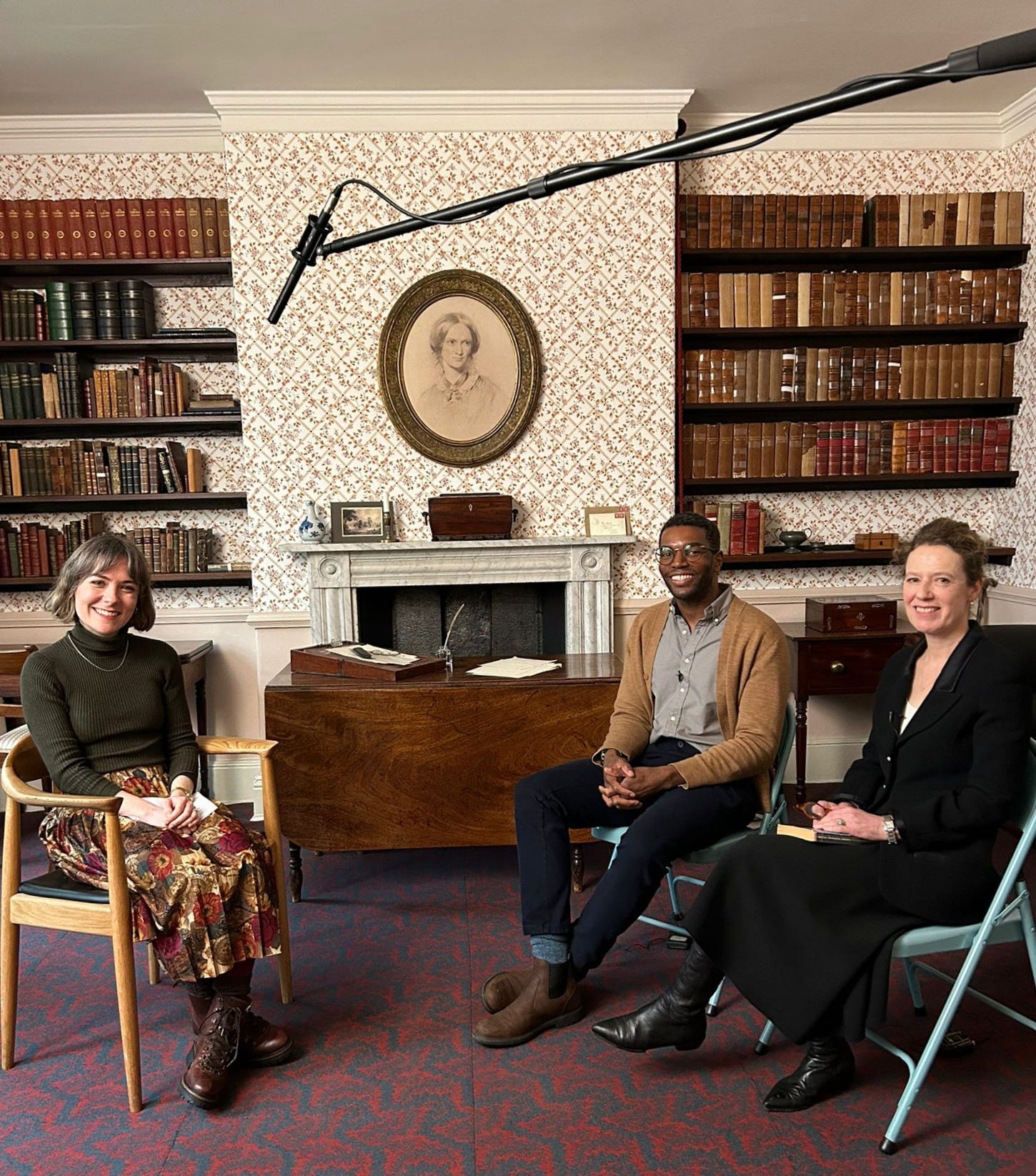
I’ve drunk too much coffee, adding jitters to the slight flutter of nerves. We hurry out into the mist, past the higgled churchyard, and up to the parsonage. We enter on the modern, museum entrance side, and are taken through into the house. There are a couple of staff about, a French news team packing up their equipment, and the videographer for our event, standing just inside the front entrance. He’s fiddling with a camera mounted onto a tall tripod, pointing through the doorway that leads to the most significant room in the house: the dining room. The space where, after dinner, the sisters were known to have paced around the table, exchanging ideas, editing out loud. The table where, it’s thought, much of the writing of their books took place. And the sofa upon which, it is generally believed, Emily Brontë died of tuberculosis, just before Christmas in 1848, aged thirty.
My guests – Lucasta Miller and Okechukwu Nzelu – are already seated, cheerfully exchanging thoughts and reflections on the book already. The usual red-rope has been drawn back, the table carefully moved to the side, and we’ve been given three modern chairs – in lieu of the precious original ones.
Being inside this room, and not just on the threshold of it, feels like being inside their world – not just looking on. I take a seat, introduce myself, and immediately see it: the sofa, on the opposite wall. Low, backless, with polished arms and black upholstery. Faded with age. Slumped in the centre by the repeated press of bodyweight.
I’ve done quite a bit of event chairing now, and it’s something I enjoy, but this one feels different. The place is quiet, there is no audience to trip me into performance mode, to quicken my pulse and thoughts. A microphone hovers in the unstirred space above us. My guests are such knowledgeable, intelligent people, and I have to put aside all else and focus on the task. But all the while, a little part of me (the part that fell in love with characters created in this house, drank in paragraphs written in this room, who had Jane’s words recited at her wedding, who poured over the pages of Wuthering Heights) is humming with the whole scene I am somehow inside. Is thinking, here I am. There she is.
The conversation, rolling out of my initial nerves and into the energy of a shared passion, goes well. The energy is good, the topics of discussion overflowing with more that could be said. We are here, ultimately, because of the explosion of publicity around Hollywood’s latest take on Emily Brontë’s only novel – which stirred much strength of feeling at the time it was published, and, clearly, continues to do so.
All the while, that black couch sits, quietly, behind the people I am talking too. It tugs gently at my attention.
What was she like? How did she look? Sound?
Does it matter?
There is a compulsion, always, for us to render those stories which ignite the imagination into something tangible, visual, voiced. To answer questions. To fix the whirl of personal interpretations into something shared, and stable. And in this most recent case: beautiful.
The three of us agree that, for this book above all, the attempt at re-creation is futile. It’s impossible to translate Wuthering Heights into anything as assured and digestible as a film. Anything that comes from it is a new piece of art: not an adaptation, but a response. It cannot take the status of ‘version’.
Our own readings, on the other hand – each of our experiences of this book, differing and evolving – these are all unique and valid versions of Wuthering Heights. A tantalizing diversity which, I am sure, Emily Brontë would have entirely endorsed.
We all agree that there is no way to know what Emily was thinking or feeling when she wrote this book.
We all agree that if this new “Wuthering Heights” (quotation marks included) points a new wave of readers back toward that original, remarkable text, then it is only a good thing. Though some of them may be a little shocked to find that ‘the greatest love story ever told,’ is, perhaps, more accurately described as horror.
At the end of the hour we climb out of the many layers of our discussion, and sit back. Job done.
I’m reluctant to leave this room. It’s gone too quickly. I’ve been too busy with the task at hand to let the weight of the space soak past my skin.
And then the producer asks if we can sit, for a minute more, in silence. He needs to gather ambient audio, to aid the editing of the footage. Of course.
We fall quiet. And for a full, beautiful minute, I get to sit between the walls of that family’s little dining room. To dwell there. To listen, through unstirred air, to its transcendent bones.
Feeling her anonymous presence underneath the trample of discourse about the story she put to paper, the final question I had asked my guests was: what they would have asked Emily? What one thing would they want to know, if they had the chance?
Okechukwu’s answer seemed to bring the creative in me, which has been lately wandering, distracted and frustrated, right back home.
‘I’d want to know if she had fun.
‘The kind of fun that writers have when you’re doing something which is frustrating and difficult and huge and complicated, but when it’s going well, you feel like you’re on top of the world.’
I know this feeling. And as Okey spoke, the sadness of the black couch in the corner fell away and was replaced by the image of a young woman, alive with the thrill of her craft; fingers stained with ink, and feet tingling with the excitement of having put just the right word on the page.
Marching on
When I was writing this piece, a magpie flew across the rooftops outside, flapping with extra vigour on account of the teetering branch, longer than its wingspan, gripped in its beak. Another landed on a chimney top to adjust the balance of a similarly awkward load, and then took off in the same direction.
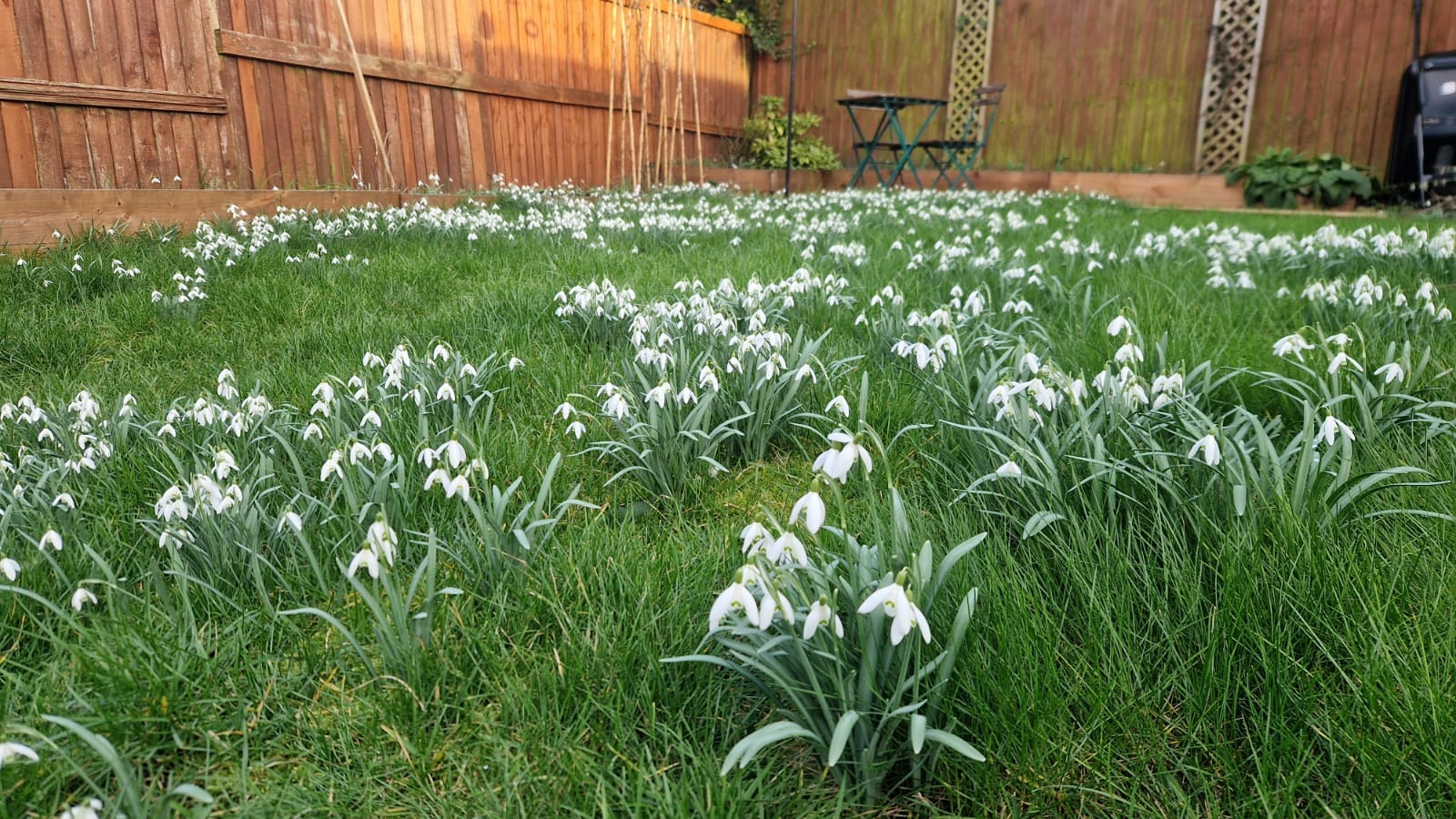
Our small, safe world is gathering itself for spring and everything that it will bring. For better or worse, the quiet season is behind us. Birdsong soaks through the bedroom curtains – a little earlier every day. The chorus of snowdrops that have been tinkling in our garden all through February are finally coming to their ragged end.
I have lots of travel coming up over the next few weeks, and I’ve been steeling myself for the tug of being away from the comfortable routine of home. There’s lots to look forward to, though. Interesting meetings, time snatched around the London Book Fair with family and friends, and celebrations for our next magazine issue – as well as the first year’s anniversary of Folding Rock.
On the 9th March, an essay of mine will be published in an anthology called The Waters That Raised Us, and along with a throng of other talented Welsh writers invited to contribute to this lovely project, I’ll be at an event to celebrate it on Tuesday 31st March in Cardiff. It’ll be nice to be the writer in the room again – even more so to be one in communion with others.
Work on the next book is slow but enjoyable. Lots of my time this month has been spent applying for support and travel grants, hunched at the altar of my computer screen. I’m longing to be out in the countryside, somewhere big and damp and windswept. I’ll be longing even more after a stint in the big smoke; dreaming of an imaginary, parallel life in the green and dripping folds of mid Wales.
Right now it’s just after 6am, and I’m on the earliest train back south to Barry, to see my sister, who is very soon expecting her first baby.
Spring is here. Everything is change. Lots of it is joyful. Wherever you are, I hope you’re able to find some too.
Till next month,
Kathryn x
This is a beautiful piece! And how amazing to sit WHERE THEY SAT.
Lovely piece, Katy! How extraordinary to step into that dining room!